
Does Amazon PPC actually create incremental sales?
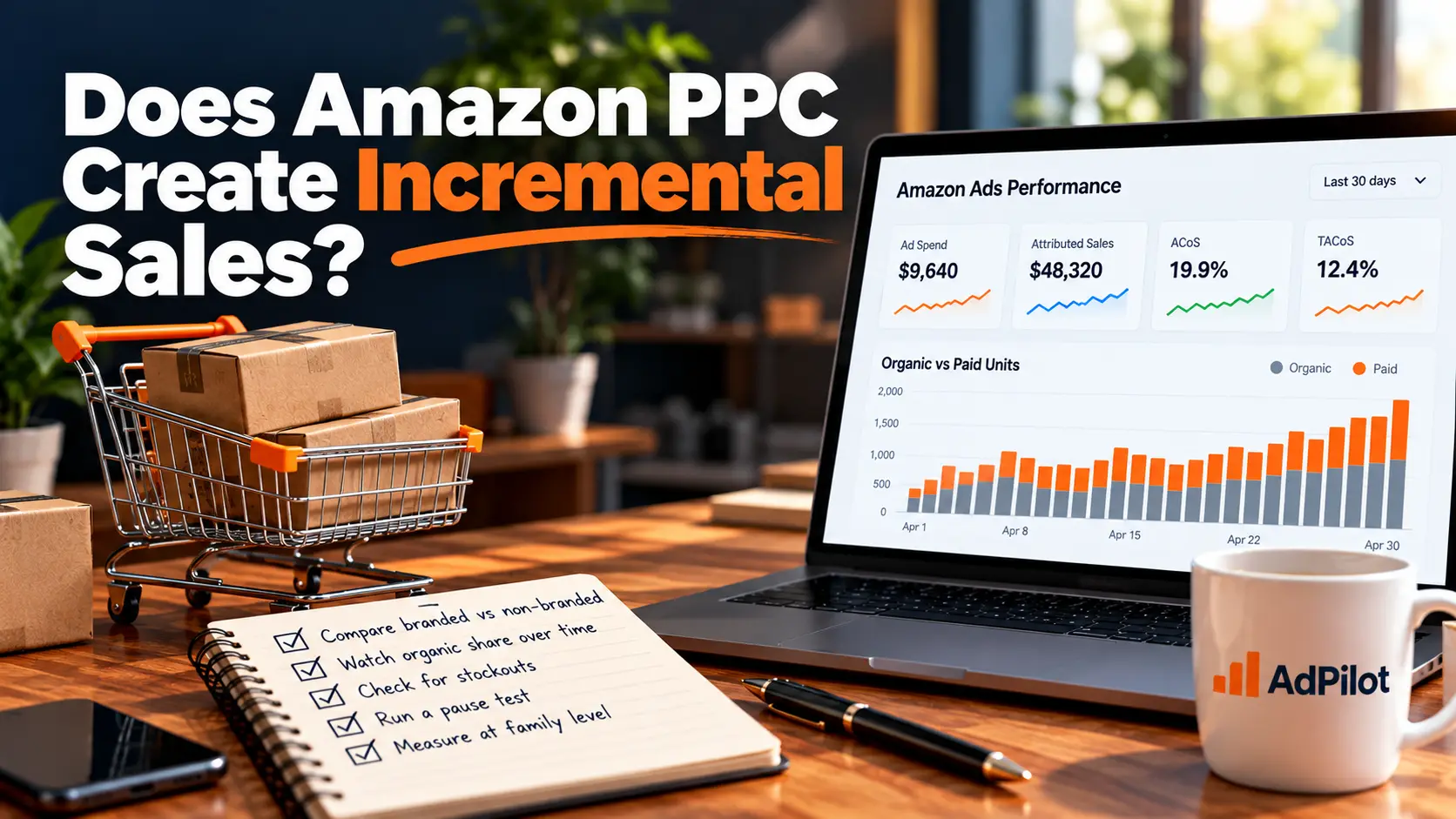
Amazon tells you how many sales your ads generated. It does not tell you how many of those sales you would have made anyway.
That gap is the most expensive thing in most advertising accounts, because it is invisible. A campaign reporting strong attributed sales and a comfortable ACoS can be paying for orders that were already coming. The report looks the same either way.
What “attributed” actually means
For Sponsored Products, Amazon credits a sale to an ad when a shopper clicked that ad and then bought the product within the attribution window, which is 14 days. That is all the word means. It is a record that a click happened before a purchase, not a finding that the click caused the purchase.
Most of the time that distinction is harmless, because the click really did do the work. It stops being harmless in three specific situations.
The three places your ads are most likely to be buying sales you already had
Your own brand name. Someone searching your exact brand has already decided. If you rank first organically for it and you also run an ad on it, the ad sits above your own free listing and collects the click. The sale was yours; you just paid a toll to receive it. This is the single most common place spend goes to sales that were never at risk.
Terms you already dominate organically. If you hold the top organic position for a keyword, an ad on that same keyword is competing partly with itself. Some of those clicks are genuinely new, from shoppers who would have scrolled past you. Some are simply shoppers who would have clicked the organic result two inches lower.
Repeat and returning buyers. Someone who has bought your product before and is reordering does not need to be reacquired. If they arrive through an ad, the ad gets the credit and you pay for a customer you already had.
None of this makes advertising on those terms automatically wrong. It does mean those are the campaigns where “attributed sales” and “sales you created” are furthest apart.
Why you probably cannot measure this cleanly
This is where most advice gets glib, so here is the honest version: proving incrementality on a single ASIN is genuinely hard, and for many sellers it is not possible with the data they have.
The problem is that the thing you are trying to detect is usually smaller than the noise around it. On a product selling a handful of units a day, ordinary week-to-week variation routinely swings wider than the lift a campaign would produce. Run a comparison across two arbitrary periods where nothing changed at all and you will still see a difference, often a large one.
Four things generate that noise, and all of them look exactly like an advertising effect:
- Stockouts. Sales collapse and recover for reasons that have nothing to do with your bids. If a product went out of stock in the middle of your test window, the test is measuring inventory, not advertising.
- Variation cannibalisation. Where sizes or colours sit under one parent, they trade sales between each other constantly. A single child ASIN can look like it is falling while the family is flat.
- Seasonality. A campaign that looks like it stopped working in February may simply be selling a product people buy in November.
- Competitor behaviour. A rival going out of stock, launching, or discounting moves your numbers without you touching anything.
This is why measuring at the variation family level, rather than one child ASIN, gives you a far better signal on products with real volume, and why small campaigns will often honestly tell you nothing at all.
What you can actually look at
Given that, three things are worth more than a precise-looking number.
The organic share trend. Track paid and organic units for the same product over months, not days. If paid sales climb while organic sales fall by a similar amount, you are shifting sales between columns rather than adding them. If both rise together, the advertising is probably doing real work: better sales velocity improves ranking, and ranking brings sales you did not pay for.
TACoS rather than ACoS. ACoS only sees the sales the ads claimed. TACoS measures ad spend against total sales, so if it drifts upward while revenue stays flat, you are buying a larger share of the same business. That is the signature of spend drifting toward sales that were already yours. We covered this alongside the margin side in how to tell whether your PPC is profitable.
A pause test, done properly. Turn one campaign off and watch total units for that product, not attributed units. The rules that make it worth doing: pick a product with enough daily volume that a change is visible above the noise, run it for at least two to three weeks, check that the product does not go out of stock during the window, and do not run it across a seasonal boundary or a Prime event. If total sales barely move, most of what that campaign was reporting was not incremental. If they fall by roughly what the campaign was claiming, it was.
That last test is blunt, and it costs you real sales if the answer turns out to be “the ads were working”. Run it on one campaign you suspect, not across the account.
What to do when the answer is “not very incremental”
The instinct is to switch those campaigns off. That is usually wrong, for one reason worth taking seriously: an ad on your own brand name is also defending the position. If you vacate it, a competitor can buy the slot above your organic listing and intercept shoppers who were searching for you specifically. You are no longer paying for incremental sales, you are paying to keep someone else from taking existing ones.
That is a real cost with a real return, but it is a defensive decision and should be argued for as one, sized deliberately rather than expanded because the ACoS looks good. A defensive campaign with a flattering ACoS will always look like your best performer, which is exactly why it quietly absorbs budget.
The useful question is not whether a campaign is incremental, but where the next pound of spend produces the most genuinely new profit. That almost always means moving budget from terms you already own toward discovery terms where the shopper did not know about you, accepting a worse-looking ACoS in exchange for sales that would not have existed. To know whether you can afford that trade, you need the margin of the product underneath it, which is what the CPC calculator works out.
The short version
Attributed sales tell you a click preceded a purchase. They do not tell you the click caused it.
Assume your brand-name campaigns, your top organic terms and your repeat buyers are the places where the two numbers diverge most. Measure at the family level, over months, with an eye on organic share and TACoS rather than ACoS alone. Accept that on low-volume products the honest answer is often that you cannot tell, and be suspicious of any tool that says otherwise with confidence.
Then spend where the sales would not have happened without you. That is the only advertising that actually grows the business, and it is the principle AdPilot is built around: knowing which sales are worth paying for, rather than collecting credit for the ones you already had.
Want to know whether your listing is the reason the clicks are not converting? Run a free audit on one of your ASINs and see what it scores before you spend more on sending traffic to it.